Santa Sangre

Alejandro Jodorowsky became famous for his psychedelic epics of the 70s. The Mexican western El Topo and the Beatles funded Holy Mountain have enjoyed something of a renaissance among today’s hipster students, and rightfully so. They belong firmly to a time when it was no rare thing for directors to have absolute creative control over their films, and they are so infused with acid-induced imagery it’s hard nowadays not to treat them with a whimsical nostalgia for a bygone era. Together they surely rank as two of the most subjectively accurate depictions of the 70s as it must have looked in the minds of the non-sober. Shamefully, I have not seen either of them in their entirety, but I don’t think my appreciation for Jodorowsky’s  1989 Santa Sangre suffers as a result.  

People tend to label Santa Sangre a ‘horror’ film. I don’t know why - it’s not particularly horrific. Chilling, maybe, but terrifying? No. It’s certainly surreal, grotesque, haunting, sexual, and violent but also  gentle, romantic, heart-warming, funny, and spectacular. Genres have always seemed to me a consumerist construct, and while they are appropriate for many films, Santa Sangre certainly isn’t one of them. When it came out in 1989 it must have seemed like a throwback to the golden age of auteurs amongst the tired re-hashes of hollywood formulae which the latter half of the 1980s was so drenched in.

It’s story follows the life of a man named Fenix played by Axel Jodorowsky (Alejandro’s son). In the beginning, we see him as a naked man in a mental asylum, and then we follow his childhood through flashback, where his younger self is played by Adan Jodorowsky (also Alejandro’s son). He is the son of two circus performers, and he himself is a child magician. He falls in love with a deaf-mute, before being separated from her when his father’s adulterous affair takes a turn for the worse. The second half of the film focuses on his adult life, and the trying relationship he endures with his mother (she has no arms, and has complete control over his, forcing him to murder numerous women).

With its focus on children’s relationships with their parents (it’s surely no coincidence that Jodorowsky cast two of his sons as the film’s protagonist) there is a lot of Freudian stuff going on here, matched by potent religious symbolism and psychosexual tension. The circus setting provides the occasion for Jodorowsky to flex his visual muscle, and he does so to a staggering degree. One sequence portrays the funeral of an elephant which is marched off in an industrial skip-sized coffin, only to be ‘buried’ in a landfill that borders a slum, and where the starving inhabitants madly rush to it for food. Furthermore, the carnivelseque presents an inverted world, where social norms cease to exist, and what stands in their place is performance, disguise, and manipulation. And those performances and disguises are so perversely captivating that you are sure to willingly submit yourself to Jodorowsky’s masterful manipulation of what seems appropriate in cinema.  


Black Pond


Chris Langham stars as a disheartened patriarch of a suburban family in this impressive debut from new comers Tom Kingsley and Will Sharpe. Filmed for around £25,000 Black Pond explains the events which led to a middle-class British family being accused of murder, and the media interest that followed as a result. One day, Tom Thompson (Langham) suddenly befriends the disconnected eccentric Blake (Colin Hurley) who he meets on a walk in a wood. The narrative that follows is told in a series of flashbacks and mockumentry style interviews with members of the Thompson family, and their friend Tim Tanaka. Interspersed among these, are delightful animated flourishes, and youtube music-videos delivered by the Thomson daughters. It is all wonderfully edited.


The end result is a delightful indie tragicomedy full of heart, and humour that is both deeply deadpan and very dry. Understandably, the film seems to have attracted the most attention because it is Chris Langham’s first work since serving a jail sentence for downloading child pornography. His own personal battles should not detract from what is a brilliant performance, and indeed the film itself, regardless of whether the filmmakers intended it or not,  seems to parallel Langham’s fall from grace. At one point, Tom Thompson states to the camera: “I lost my job because of the publicity”.

Perhaps one of Black Pond’s greater successes is the film’s ability to treat well-worn subject matter, suburban disenchantment, with ever witty panache. Tom Thompson used to have fantastic adventures in his sleep, but now dreams of broadband and ham sandwiches. He admits that he has a tedious life, but at least he has a nice swimming pool in the summer. His wife, Sophie Thomson (Amanda Hadingue), used to write poetry, though she now calls them suicide letters, and has no hesitation in declaiming John Clay’s verse to strangers. Their marriage has disintegrated to the point where the only conversations they have are arguments about whether bananas are a suitable night-time snack or not. Their daughters Katie (Anna O’Grady) and Jess (Helen Cripps) are less fleshed out characters, though their shy and introverted flatmate, Tim, is amusingly executed by Sharpe. I get the impression (and I hope it’s true) that there was a significant amount of improvisation in the scenes he shared with Simon Amstell, who plays a bizarre and fraudulent psychologist.

In its haunting surrealism,  melancholy, and deadpan comedy, Black Pond reminded me of Chris Morris’ television series, Jam. Also, the lines delivered by Blake, which are so eccentrically British, recalled the animations of David Firth, whose most famous for the Salad Fingers series. There is no way of knowing whether Kingsley and Sharpe were familiar of Firth’s work, but they are certainly the right age to be at least aware of it. Maybe the similarity is coincidental. All in all, Black Pond is an impressive debut, that will make you laugh, might even make you cry, and with its modest 80-minute length, definitely deserves your time.  

Prometheus


Hype can be harmful for any film— it clouds judgement and invariably only leads to disappointment. And whilst Prometheus isn’t wholly disappointing, the feeling it leaves you with is somewhat distanced from the giddy buzz which surrounded its release. Nevertheless, it does entertain and keeps you involved thanks to stunning visual effects and a haunting performance from Michael Fassbender who plays the mendacious android David. There are some great cinematic set-pieces on offer, in particular a scene involving an automated surgical table and an unwanted guest, will, I am sure, go down in movie history. This is all expounded by stellar set-design: the central space which contains that sculpted humanoid head so publicised in the marketing posters, drips with foreboding, tension and beauty.  


The crew of Prometheus commit to an expedition which hopes to find the origin of life on earth. Based on the hypothesis of two archaeologists, a ship consisting of a world-class crew is commissioned  to explore a planet 34.5 light years away which, so the archaeologists believe, is home to the creatures who made us. It turns out to be slightly different to what they had hoped to find, and things start to go wrong very quickly. As is inevitable for a film with this sort of premise (that creatures from outer space ‘engineered’ human life on earth) the script is loaded with ambitiously philosophical themes which ricochet throughout the narrative in terms of children struggling against fathers, and creations battling with their creators. Things become very oedipal very quickly. This is not necessarily a bad thing- creation myths from all cultures and times burst with this sort of primitivism and Prometheus handles these themes with intelligence. I would explore these more deeply, but to do so would give away too many spoilers.

It seems wrong to judge Prometheus against Alien. The 1979 film is a modern classic that redefined the Science-Fiction genre and spawned a billion-dollar media franchise which consisted of not only the three movie sequels, but also numerous books, comics, and computer games. Yet, the only reason Prometheus has been hyped so much is because of its relationship with that film. And the fact that Ridley Scott was set to direct it, made for a fan’s wet dream. It is in this respect that the film can feel less than satisfying, it opens more question than it answers, and the whole ‘quasi-Alien prequel’ seems more like a marketing ploy than anything else. Yes, there is something in the last few minutes which directly links the movie with the Alien series, but it appears more like a customary add-on, rather than a poignant climax to a narrative that drives towards it. As a stand-alone film Prometheus is entertaining, visually stunning and more often than not, well executed. However, if we consider it as the father to the Alien franchise, then it fails to deliver anything special, perhaps fittingly so, for as the film shows, children will inevitably destroy those who created them, and Alien far exceeds anything that Prometheus achieves, even if the 2012 film is three-dimensionally spectacular. 

Bellflower


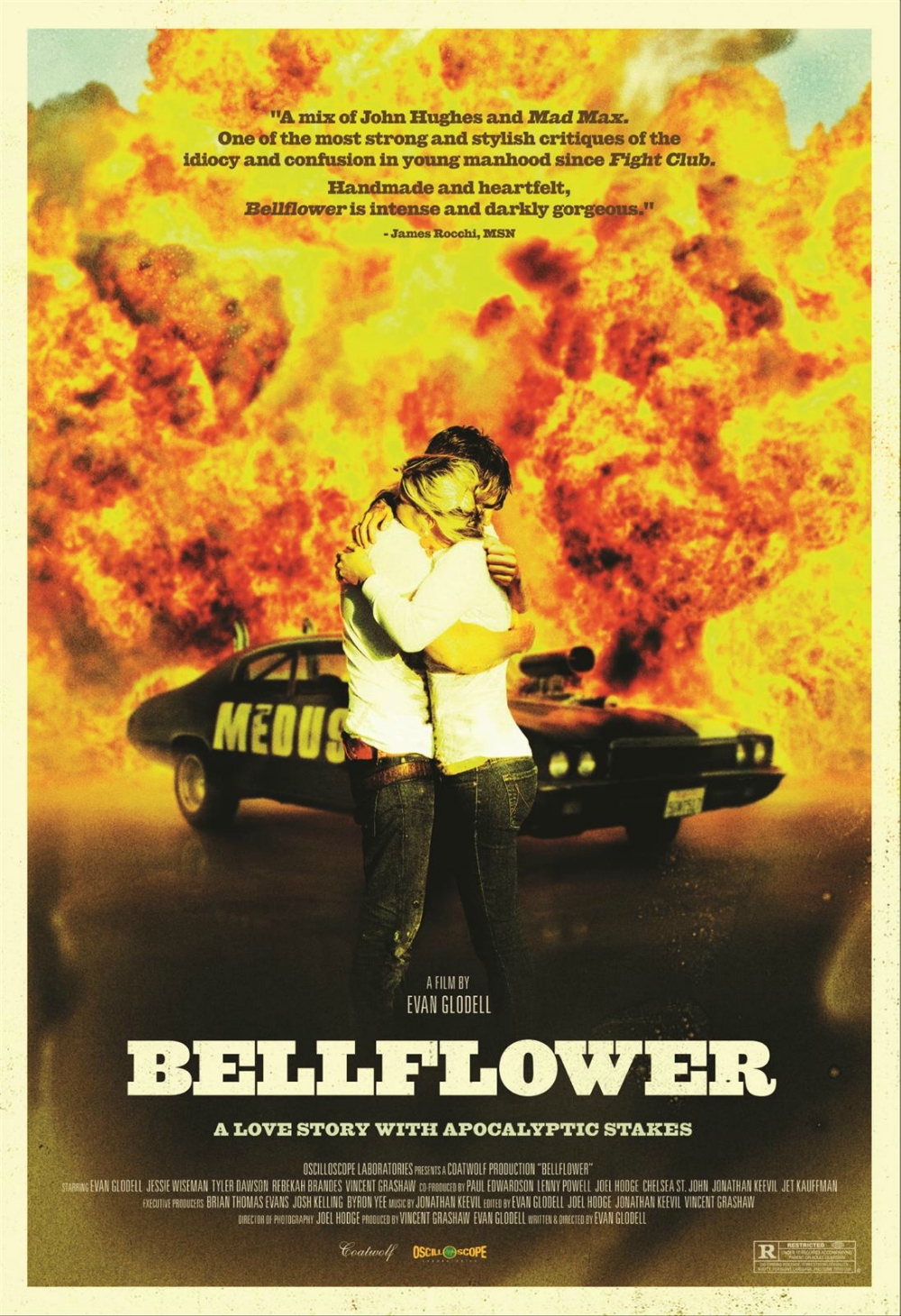
Bellflower is an intoxicating, and beautifully messy film, which tells the story of two young men who spend their time creating and tinkering with flame throwers and other weapons of mass destruction, so as to be prepared for a global apocalypse. Along the way, one falls in and out of love with a girl, and in doing so, experiences the destruction of the world in his own personal way. His destruction pollutes everyone around him, as one of the chapter titles tells us ‘Nobody Gets Out of Here Alive’. Apocalypse courses through the narrative, embeds itself into the films cinematography, editing, and emotional punch. Though the end of the world never actually occurs, all the characters, in their own tragic way, experience a physical and spiritual destruction, catalysed by their post-adolescent angst.


Typically, I prefer to review films in a ‘death of the author’ kind of way, disregarding who made them, or how they were made. This Barthesian approach seems particularly suitable for films, because they are, by their nature, always a collaborative effort, only a very few number of pictures can boast to have a director with complete creative control behind them. However, with Bellflower it seems inappropriate to disregard its context, because the methods behind its production, and how much money was used to create it, make the film something particularly and spectacularly special.

Evan Glodell wrote, directed, co-produced, starred in, and co-edited Bellflower. He even made the camera used to shoot the film, as well as creating its more important props. Prop design may not seem that big a deal, but when one of the set-pieces is a Mad-Max-ian, flame-throwing, post-apocalyptic car fitted with fully functional dash-mounted surveillance cameras, an integrated smoke-screen generator and lever-toggled suspension, it is, to use the parlance of the movie’s characters, pretty fucking awesome. Equally home-grown is the camera used to capture it all: it stands as an assemblage of various camera parts, vintage and Russian lenses, all mounted around a Silicon Imaging SI-2K Mini Digital Cinema camera. This allowed cinematographer Joel Hodge to create the film’s deservedly praised and highly distinctive look. At the beginning of my viewing, I spent a good few minutes trying to clean the dirt off my laptop, however I soon realised that all the dust was actually on the camera’s lenses. Bellflower looks dirty. Its sultry, sordid and suburban setting inherently lends a post-apocalyptic aesthetic, as if the footage was recovered from a radioactive pile of nuclear fallout. Oh, by the way, it was all filmed for under $20,000.


The film has divided critics and viewers. Many, to my surprise, have found fault with the performances on show here. To be sure, they’re not nuanced, nor are they executed with finesse. But the characters themselves, are hardly elegant or emotionally mature - the film starts with them in a cricket eating contest for god’s sake. They’re jobless, wash-ups who consider flame-thrower construction a healthy hobby, and do nothing but drink, take drugs and have sex only to hurt one another. So the amateur acting on display perfectly matches what the script demands. I was constantly reminded of Bully when watching this, both portray that frustrated angst of disaffected youth, where underemployment and lack of direction can only lead to destruction. In my view, Aiden (Tyler Daweson) stands out as the film’s emotional core, and only likeable character. His monologue at the end, with its surely self-conscious homoerotic undertones, brought a tear to my eye.

Bellflower is an important film and deserves every bit of praise it can get. It’s Evan Glodell’s debut, and an explosive one at that. Regardless of whether the film appeals to your tastes, watching it is not a forgettable experience. And Evan Glodell is definitely a towering talent to watch. It’s miniscule budget, impressively unique cinematography and exhilarating explosions prove that you do not need the latest in 3-D or computer-generated imaging to make a film that packs a visual punch. 

Kill List


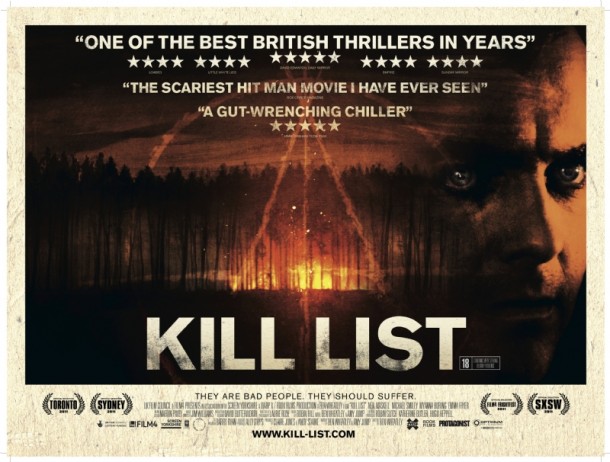
Ben Wheatley’s Kill List is a 2011 horror film, hyped to be a resurrector and reanimator of  British Cinema which apparently has been the victim of a ‘chronic medical condition’.  However, I find this view unsatisfactory. Although British Cinema has always struggled to reach the first ranks of world cinema, it’s never stagnated or deteriorated; the previous decade saw the likes of Moon, Layer Cake, 28 Days Later, The Wind that Shakes the Barley and the list could go on. So why it has fallen on Ben Wheatley’s humble, and comparatively obscure, sophomore effort to project the entire nation’s film industry to global stardom, baffles me.   


One can only give the bare essentials of the plot without spoiling the many twists and turns the narrative provides. The film starts with a violent argument between a husband and wife, over money and work. Shel (MyAnna Buring) has had enough of her lazy husband, who’s been without work for eight months, and who shows no sign of securing another job. Jay (Neil Maskell), an Iraq war veteran, blames his bad back, which only an expensive jacuzzi can cure. Shel shouts back “It’s all in your head”.
              
The (verbal) violence with which the film starts will escalate, and spill over as the narrative progresses, reaching dire depths of hyperbolic ghastliness, as bodies are hacked to pieces and bludgeoned to pulp. In a similar vein, the plot itself and the genres the film encapsulates, are similarly chopped apart, mangled, and reincorporated to create a movie that is at once eerily familiar and grotesquely alien. Allusions to previous films abound, and most of them British. The brilliantly tense domestic scenes of the first act recall the kitchen sink dramas of the 50s and 60s. The second act, which follows the two leads carrying out contracted killings, reeks of Taranatino and Guy Ritchie, and the ever-so-slightly-ridiculous third act seems only explicable as a post-modern supplication to one British horror classic in particular, but to name which one would spoil the surprise.


Because of its pastiche nature, there is a lot here that will leave most viewers scratching their heads. The plot does go to some very unexpected places and many characters do things that are inexplicable. I have only seen the film once, and perhaps re-watching it might give some answers, but I highly doubt it. The main theme here is violence, and, as Kill List shows,  violence takes many forms. It operates when a wife screams at her lay about husband, when a soldier fights a war, when Catholics and Protestants battle in Ireland, when two best friends solve their disagreements with a childish wrestle, when a cat kills a rabbit and leaves the entrails as an offering to its keepers, or when man repeatedly smashes another man’s skull in with a hammer.  Violence is never ordered, and never meditated, it gets out of control, and so does Kill List. And this makes for a riveting and chilling film, which, whilst not able to bear the entire burden of British Cinema on its back, is still able to breathe some new life into its Horror genres, and it does this in a wonderfully British way. 

Weekend


Weekend tells the tale of Russel and Glen who, after a one night stand, embark on an intense but fleeting relationship. In its apparent simplicity there is so much complexity to admire here. Most worthy of applause are the performances given by the two lead actors, Tom Cullen, who plays the introverted Russel, and Chris New, as the energetic and proud Glen.

It is not often that a work of fiction allows you to forget its authored. So often in contemporary cinema, we are constantly confronted with pulsing narrative, flashy photography and witty dialogue, to the extent that we are always alert to the fact we are watching a film. However, Weekend flows along with a naturalism so brutal that it makes you forget that what you see is in fact scripted. Yet to do so would run the risk of missing how artful the film really is. Consider the sex scenes for example, it is only when we get to know the characters fully that we are allowed to share these moments with them. Moments which are explicit in their honesty.


In terms of narrative, Weekend belongs to that sub-genre of Romance films which more or less consist of  two people talking about love. Richard Linklater’s Before Sunrise and After Sunset come to mind, and with regards to British Cinema, it also happily recalls David Lean’s Brief Encounter.  However, what makes this film unique is its gloriously modern twist on the Romance genre. In the world of Weekend (which is the world we live in) casual, fleeting sex is not taboo. Instead, what is not spoken of is the possibility of emotional attachment which sex brings. Russel writes a secret log about the men he sleeps with, preferring to describe their personalities. Glen, on the other hand, is more frank. Using a dictaphone, he interviews every man he sleeps with, and makes sex the primary focus of this conversation. By keeping a personal record of their sexual partners, both characters express an unspoken desire to form an attachment to those anonymous men with whom they sleep. Neither allow a one-night stand to just be a one-night stand.

The film was shot in Nottingham, but this is never obvious, and the location’s anonymity adds to its universal message. And universality is not confined to sexuality, something which audiences, both gay and straight, should remember. At one point, Glen laments that his art project will not be seen:

“No one’s gonna come and see it, because it’s about gay sex. So the gays will only come because they want a glimpse of a cock. And the straights won’t come because, well, it’s got nothing to do with their world.”

Unfortunately, this prediction for “gay” art can be applied for Weekend itself. Whilst doing moderately well in American Cinemas, it did not enjoy the widespread distribution and viewership it deserved in Britain. Still, it’s available on Blu-Ray and DVD, and I would encourage anyone to watch it. People in the USA get to enjoy this wonderful Criterion release..


Gatsby Revisited


With the trailer for Baz Luhrmann’s latest effort doing the rounds on Facebook, it seemed appropriate to watch the film which precedes it, and which boasts an equally impressive cast: Mia Farrow as Daisy Buchanan, Robert Redford as Jay Gatsby. Of course, I could have reread the book which precedes it, but that seems pointless, we’re in the world of film not literature, and alas, I did not do A-Level English.


The Luhrmann trailer indicates that 2012’s Great Gatsby will be bursting with (insipid) frivolity. Two screenshots I feel typify what the film will entail. Take this New York skyline for example:


You’d be forgiven for thinking this was grabbed from a video game, let’s say: Grand Theft Auto: Steam Punk Edition (they’ve even gone to the effort of rendering a zeppelin!). It looks so entirely fake that we’d be hard pushed to care about any of the inhabitants of this place, but there you are, this is what we’ve been so shown and we have to make do. What follows in the trailer is a series of vignettes saturated with gargantuan decadence. It’s fun, camp, and pointless. For example:


Look at all those Martini glasses, all nine of them! Neatly arranged on piled up books. It looks like a bad fashion advertisement. Perhaps this is all self-conscious. Perhaps the booze has been given centre stage, and the characters sidelined, in order to enhance the shallowness of their lives. 3-D cinematography juxtaposed with 2-D characters etc.  But I doubt it. The trailer revels in what it depicts, and we are invited to do the same. Wonderful rococo escapism while the world goes through yet another recession.

All this is so utterly and completely antithetical to the 1974 effort, which Vincent Canby lamented was “as lifeless as a body that’s been too long at the bottom of a swimming pool”. Whilst I wouldn't wholly subscribe to this view, I can see where he's coming from. But it’s prosaic tone is certainly more preferable to the one Luhrmann employs. It allows room for tension, it doesn’t condescend the audience by shoving their faces into the extravagance on show, and as a result, lets us breathe with the characters. Even so, in order to fully appreciate it, reading the novel is a prerequisite. This begs the question: why bother filming the book at all? Surely not to help all those teenage pupils get the grades they need by putting the least amount of work in as possible..