Attack the Block

As fireworks ascend and explode in the London skies, down below in the city’s streets a Kennington gang of teenagers mug a defenceless nurse on her way home from work. The incident is cut short when an unidentified object crashes down from space and wrecks a car. This object turns out to be an alien, which the gang’s leader Moses (Joh Boyega), promptly slaughters, much to the delight of his hooded colleagues. However, this murder causes a full on alien invasion, and forces the gang to find common ground with opposing groups in order to survive.


Nowadays it seems necessary for indie genre films such as this to be self-consciously aware of their status as genre films. Nods must be made to previous movies, and critics must acknowledge them. Attack the Block is no different, but the way it twists generic expectations breathes a refreshing sincerity on an otherwise tired irony. The opening moments show a gang of kids on bicycles, carrying an alien. Obviously, the allusion here is to Spielberg’s spell-binding E.T. However, 80’s American suburbia has been replaced by the grim reality of 21st century London urbanism, and those bicycles are now BMXs, that Alien is now a terrifying lupine monster with giant claws and glow-in-the dark teeth, and those kids are armed with knives and speak urbane patois-slang. I’m not sure how well Eliot’s E.T. would have fared with this lot.  However, as the film goes on, and the body count rises, the gang of youths are made to reconcile with their adversaries. The nurse they mugged (Jodie Whittaker) becomes a key member of the group’s survival team, and posh kid Brewis (Luke Treadway) is integral in solving the riddle of the alien’s invasion.

Fittingly, for a film about aliens, alienation is a recurring theme. With British newspapers dominated by horror stories of gang violence, stabbings, and muggings coming from London’s estates, a contemporary film set there would surely have resonances. Attack the Block handles this side of things very well. It allows for pauses where the teenagers’ backgrounds and upbringings can be glimpsed it, and taken into account. Sometimes, the harsh reality of life on an estate is terrifyingly alluded to. I’m thinking of the scene where arch-drug dealer Hi-Hatz (Jumayn Hunter) casually waves his gun’s aim between two children for information. These two children are so keen to impress their elders, that they fill a super-soaker with petrol to ignite with firecrackers. Also, and I don’t know whether this was intentional or not, the shots of the estate’s main building (as can be seen in the promotional posters as well as in film) bear a striking resemblance to an alien space ship, as if to say these inner-city kids are the society’s real extra-terrestrials.

However, it’s important to not get carried away. This is no Kidulthood. Instead, Attack the Block is an energetic science-fiction horror which never takes itself too seriously, and allows for some laughs (and some emotion) on the way. Its comedian Joe Cornish’s debut, and a brilliantly confident one at that.              

Stanley Kubrick: Photographer


Spent the majority of last week in Belgium, where there was a brilliant exhibition entitled ‘Stanley Kubrick: Photographer’ on show at the Musées Royaux des Beaux-Arts in Brussels. It has always been common knowledge that Kubrick spent the formative years of his life as a photographer, and prints of the work done during this period have recently been made available for purchase through the website V&M. However, aside from a few examples in odd books on the director’s films, there has never been much attention paid to his photography. Of course, this probably was a result of technical difficulties, they were undoubtedly owned by Look magazine, and as a result, hard to find. Even so, an exhibition such as this seems to have been a long time coming, and I couldn’t be more thrilled to have got a chance to see it.


As far as film directors and museums are concerned, it is really only exhibitions such as this one that are worthwhile. Too often museums are wont to put on grand displays of movie memorabilia, props, and ephemera. While these surely have some sort of whimsical curiosity, and are no doubt interesting for fans, I think they struggle to amount to anything more than simple nostalgia; they certainly don’t tell us anything interesting or insightful about the director’s spiritual, artistic, and informative biography (seeing an ape costume from 2001 is hardly going to make someone appreciate the film better). Thankfully, Kubrick’s photography does tell us about all these things, and  the fact that the photographs are quite nicely nostalgic too is an added bonus!


It will hardly be surprising to someone unacquainted with Kubrick’s life, but aware of his films, that the director had his artistic beginnings in photography. The cinematography of his films is not only perfect, but also frequently technologically groundbreaking. Barry Lyndon is a famous example. It contains many scenes filmed with a lens built by the Carl Zeiss company for N.A.S.A, which had the largest aperture of any lens built for motion pictures, with an f-stop of 0.7. Kubrick was also among the first handful of filmmakers to employ the then-revolutionary steadicam and used it to its fullest potential in the Shining. As Cinematographer John Alcott said of him, ‘he is, in his heart of hearts, a photographer’.

The photographs on display in Stanley Kubrick: Photographer are a testament to the photographer inside the director. Many of the pictures display real ingenuity and creativity from the young artist, and reveal a method that would become one of the most recognisable visual styles of the 20th century. They create a complex tapestry of drama, light, shadow, irony, and melancholy to communicate that nihilistic hopefulness which warmly taints all his major films. Of particular interest was the emphasis on the Gaze in his work which would of course become a primary visual motif throughout his filmography. On several occasions throughout the exhibition we are confronted with images which are focused on the viewing subject rather than the viewed object, we’re reminded of Alex DeLarge’s cold state in A Clockwork Orange, or Jack Torrence’s murderous gaze in the Shining, or even Alice Harford’s ambiguous grin in Eyes Wide Shut. More than this, there were a few other photographs that had more than a passing similarity to some famous Kubrickian moments, I leave these collated below. 


A nuclear researcher at Columbia University compared with Peter Sellers in Dr. Strangelove


Two young girls walking along a cobbled street in a coastal town in Portugal compared with the haunting twins from The Shining.


Who watches the Watchmen?


Recently rewatched Hollywood’s 2009 (re)production of Alan Moore’s 1986-87 twelve-issue comic book series Watchmen. I first saw it at the cinema after recently reading the graphic novel, which I loved. Whilst it was obvious the film wasn’t particularly great, it was nonetheless a thrilling companion piece to the graphic novel and its mis-en-scène recreated the comic’s panels so perfectly it was hard not to be disappointed. Of course, the ending was different, but it had to be, there was no way it could have been credibly recreated on film, and they alternative offered worked just as well.

But re-watching a couple of years later, with the novel not so fresh in my mind, the movie comes across differently. It’s hard to see anything beyond its Hollywood gluttonous sheen. The characters appear desperately shallow, and the actors seem aware of this. Patrick Wilson just about manages to bring Night Owl II together, but for people who don’t know the book (or the actor for that matter) he would seem out of place. Malin Åkerman fails abysmally as Silk Spectre II, but the script hardly helps. So trapped is the character in a masculine construct she is never allowed to breathe.


This is all a shame because the graphic novel was so revered, intelligent, and seminal. Moore’s writing adjusted superhero diction to destabilize generic expectations and questioned the politics of traditional comic book writing. The heroes are constructed precisely in order to deconstruct the ideas of what a superhero actually is, and heroes, be they fictional or real, always have social or political implications. More than this, in its staggering self-consciousness, the comic was about comics. It even had a comic-book written and drawn within its panels. It doesn’t get more meta than this.


However, Zak Snyder’s film eschews much of what makes Moore’s work still great. The then refreshingly contemporary cold-war context was of course important, but emphasising current affairs in such a way always runs the risk of making a work age irreversibly. This is not so with the Watchmen because of the points I made above, as long as there are comic books around, and as long as we continue to write heroes into films, books, games, and TV shows, the Watchmen will always have a place. Snyder, however, preferred to focus and enhance the story’s cold war setting, its violence and sex. This might have been great, the film could have taken an ironic approach to Hollywood’s appropriation of comic book material, in the way, James Gunn’s Super tried (and failed) to. Yet, Snyder is not intelligent enough to have done this. Instead we are left with a film that only entertains as long as there are bad guys being beaten-up on the screen. Moore awoke his readers to a brutal nihilism-- the only thing appropriate in a world which daily woke up to the threat of total extinction. With Hollywood’s Watchmen the nihilism can only be created by the viewer, and it comes in the form of despising and lamenting yet another rehash of comic-book adaptation. 

Santa Sangre

Alejandro Jodorowsky became famous for his psychedelic epics of the 70s. The Mexican western El Topo and the Beatles funded Holy Mountain have enjoyed something of a renaissance among today’s hipster students, and rightfully so. They belong firmly to a time when it was no rare thing for directors to have absolute creative control over their films, and they are so infused with acid-induced imagery it’s hard nowadays not to treat them with a whimsical nostalgia for a bygone era. Together they surely rank as two of the most subjectively accurate depictions of the 70s as it must have looked in the minds of the non-sober. Shamefully, I have not seen either of them in their entirety, but I don’t think my appreciation for Jodorowsky’s  1989 Santa Sangre suffers as a result.  

People tend to label Santa Sangre a ‘horror’ film. I don’t know why - it’s not particularly horrific. Chilling, maybe, but terrifying? No. It’s certainly surreal, grotesque, haunting, sexual, and violent but also  gentle, romantic, heart-warming, funny, and spectacular. Genres have always seemed to me a consumerist construct, and while they are appropriate for many films, Santa Sangre certainly isn’t one of them. When it came out in 1989 it must have seemed like a throwback to the golden age of auteurs amongst the tired re-hashes of hollywood formulae which the latter half of the 1980s was so drenched in.

It’s story follows the life of a man named Fenix played by Axel Jodorowsky (Alejandro’s son). In the beginning, we see him as a naked man in a mental asylum, and then we follow his childhood through flashback, where his younger self is played by Adan Jodorowsky (also Alejandro’s son). He is the son of two circus performers, and he himself is a child magician. He falls in love with a deaf-mute, before being separated from her when his father’s adulterous affair takes a turn for the worse. The second half of the film focuses on his adult life, and the trying relationship he endures with his mother (she has no arms, and has complete control over his, forcing him to murder numerous women).

With its focus on children’s relationships with their parents (it’s surely no coincidence that Jodorowsky cast two of his sons as the film’s protagonist) there is a lot of Freudian stuff going on here, matched by potent religious symbolism and psychosexual tension. The circus setting provides the occasion for Jodorowsky to flex his visual muscle, and he does so to a staggering degree. One sequence portrays the funeral of an elephant which is marched off in an industrial skip-sized coffin, only to be ‘buried’ in a landfill that borders a slum, and where the starving inhabitants madly rush to it for food. Furthermore, the carnivelseque presents an inverted world, where social norms cease to exist, and what stands in their place is performance, disguise, and manipulation. And those performances and disguises are so perversely captivating that you are sure to willingly submit yourself to Jodorowsky’s masterful manipulation of what seems appropriate in cinema.  


Black Pond


Chris Langham stars as a disheartened patriarch of a suburban family in this impressive debut from new comers Tom Kingsley and Will Sharpe. Filmed for around £25,000 Black Pond explains the events which led to a middle-class British family being accused of murder, and the media interest that followed as a result. One day, Tom Thompson (Langham) suddenly befriends the disconnected eccentric Blake (Colin Hurley) who he meets on a walk in a wood. The narrative that follows is told in a series of flashbacks and mockumentry style interviews with members of the Thompson family, and their friend Tim Tanaka. Interspersed among these, are delightful animated flourishes, and youtube music-videos delivered by the Thomson daughters. It is all wonderfully edited.


The end result is a delightful indie tragicomedy full of heart, and humour that is both deeply deadpan and very dry. Understandably, the film seems to have attracted the most attention because it is Chris Langham’s first work since serving a jail sentence for downloading child pornography. His own personal battles should not detract from what is a brilliant performance, and indeed the film itself, regardless of whether the filmmakers intended it or not,  seems to parallel Langham’s fall from grace. At one point, Tom Thompson states to the camera: “I lost my job because of the publicity”.

Perhaps one of Black Pond’s greater successes is the film’s ability to treat well-worn subject matter, suburban disenchantment, with ever witty panache. Tom Thompson used to have fantastic adventures in his sleep, but now dreams of broadband and ham sandwiches. He admits that he has a tedious life, but at least he has a nice swimming pool in the summer. His wife, Sophie Thomson (Amanda Hadingue), used to write poetry, though she now calls them suicide letters, and has no hesitation in declaiming John Clay’s verse to strangers. Their marriage has disintegrated to the point where the only conversations they have are arguments about whether bananas are a suitable night-time snack or not. Their daughters Katie (Anna O’Grady) and Jess (Helen Cripps) are less fleshed out characters, though their shy and introverted flatmate, Tim, is amusingly executed by Sharpe. I get the impression (and I hope it’s true) that there was a significant amount of improvisation in the scenes he shared with Simon Amstell, who plays a bizarre and fraudulent psychologist.

In its haunting surrealism,  melancholy, and deadpan comedy, Black Pond reminded me of Chris Morris’ television series, Jam. Also, the lines delivered by Blake, which are so eccentrically British, recalled the animations of David Firth, whose most famous for the Salad Fingers series. There is no way of knowing whether Kingsley and Sharpe were familiar of Firth’s work, but they are certainly the right age to be at least aware of it. Maybe the similarity is coincidental. All in all, Black Pond is an impressive debut, that will make you laugh, might even make you cry, and with its modest 80-minute length, definitely deserves your time.  

Prometheus


Hype can be harmful for any film— it clouds judgement and invariably only leads to disappointment. And whilst Prometheus isn’t wholly disappointing, the feeling it leaves you with is somewhat distanced from the giddy buzz which surrounded its release. Nevertheless, it does entertain and keeps you involved thanks to stunning visual effects and a haunting performance from Michael Fassbender who plays the mendacious android David. There are some great cinematic set-pieces on offer, in particular a scene involving an automated surgical table and an unwanted guest, will, I am sure, go down in movie history. This is all expounded by stellar set-design: the central space which contains that sculpted humanoid head so publicised in the marketing posters, drips with foreboding, tension and beauty.  


The crew of Prometheus commit to an expedition which hopes to find the origin of life on earth. Based on the hypothesis of two archaeologists, a ship consisting of a world-class crew is commissioned  to explore a planet 34.5 light years away which, so the archaeologists believe, is home to the creatures who made us. It turns out to be slightly different to what they had hoped to find, and things start to go wrong very quickly. As is inevitable for a film with this sort of premise (that creatures from outer space ‘engineered’ human life on earth) the script is loaded with ambitiously philosophical themes which ricochet throughout the narrative in terms of children struggling against fathers, and creations battling with their creators. Things become very oedipal very quickly. This is not necessarily a bad thing- creation myths from all cultures and times burst with this sort of primitivism and Prometheus handles these themes with intelligence. I would explore these more deeply, but to do so would give away too many spoilers.

It seems wrong to judge Prometheus against Alien. The 1979 film is a modern classic that redefined the Science-Fiction genre and spawned a billion-dollar media franchise which consisted of not only the three movie sequels, but also numerous books, comics, and computer games. Yet, the only reason Prometheus has been hyped so much is because of its relationship with that film. And the fact that Ridley Scott was set to direct it, made for a fan’s wet dream. It is in this respect that the film can feel less than satisfying, it opens more question than it answers, and the whole ‘quasi-Alien prequel’ seems more like a marketing ploy than anything else. Yes, there is something in the last few minutes which directly links the movie with the Alien series, but it appears more like a customary add-on, rather than a poignant climax to a narrative that drives towards it. As a stand-alone film Prometheus is entertaining, visually stunning and more often than not, well executed. However, if we consider it as the father to the Alien franchise, then it fails to deliver anything special, perhaps fittingly so, for as the film shows, children will inevitably destroy those who created them, and Alien far exceeds anything that Prometheus achieves, even if the 2012 film is three-dimensionally spectacular. 

Bellflower


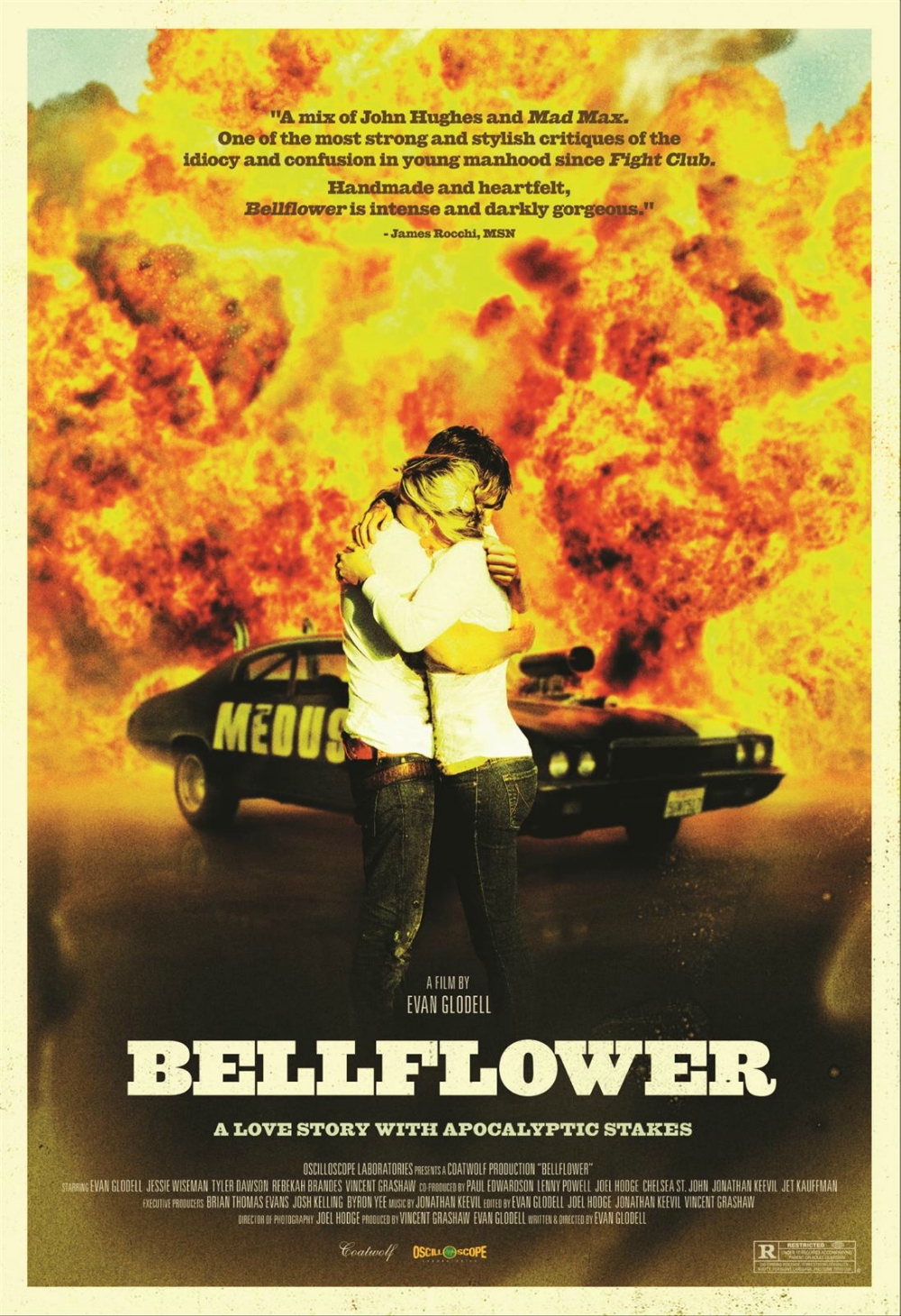
Bellflower is an intoxicating, and beautifully messy film, which tells the story of two young men who spend their time creating and tinkering with flame throwers and other weapons of mass destruction, so as to be prepared for a global apocalypse. Along the way, one falls in and out of love with a girl, and in doing so, experiences the destruction of the world in his own personal way. His destruction pollutes everyone around him, as one of the chapter titles tells us ‘Nobody Gets Out of Here Alive’. Apocalypse courses through the narrative, embeds itself into the films cinematography, editing, and emotional punch. Though the end of the world never actually occurs, all the characters, in their own tragic way, experience a physical and spiritual destruction, catalysed by their post-adolescent angst.


Typically, I prefer to review films in a ‘death of the author’ kind of way, disregarding who made them, or how they were made. This Barthesian approach seems particularly suitable for films, because they are, by their nature, always a collaborative effort, only a very few number of pictures can boast to have a director with complete creative control behind them. However, with Bellflower it seems inappropriate to disregard its context, because the methods behind its production, and how much money was used to create it, make the film something particularly and spectacularly special.

Evan Glodell wrote, directed, co-produced, starred in, and co-edited Bellflower. He even made the camera used to shoot the film, as well as creating its more important props. Prop design may not seem that big a deal, but when one of the set-pieces is a Mad-Max-ian, flame-throwing, post-apocalyptic car fitted with fully functional dash-mounted surveillance cameras, an integrated smoke-screen generator and lever-toggled suspension, it is, to use the parlance of the movie’s characters, pretty fucking awesome. Equally home-grown is the camera used to capture it all: it stands as an assemblage of various camera parts, vintage and Russian lenses, all mounted around a Silicon Imaging SI-2K Mini Digital Cinema camera. This allowed cinematographer Joel Hodge to create the film’s deservedly praised and highly distinctive look. At the beginning of my viewing, I spent a good few minutes trying to clean the dirt off my laptop, however I soon realised that all the dust was actually on the camera’s lenses. Bellflower looks dirty. Its sultry, sordid and suburban setting inherently lends a post-apocalyptic aesthetic, as if the footage was recovered from a radioactive pile of nuclear fallout. Oh, by the way, it was all filmed for under $20,000.


The film has divided critics and viewers. Many, to my surprise, have found fault with the performances on show here. To be sure, they’re not nuanced, nor are they executed with finesse. But the characters themselves, are hardly elegant or emotionally mature - the film starts with them in a cricket eating contest for god’s sake. They’re jobless, wash-ups who consider flame-thrower construction a healthy hobby, and do nothing but drink, take drugs and have sex only to hurt one another. So the amateur acting on display perfectly matches what the script demands. I was constantly reminded of Bully when watching this, both portray that frustrated angst of disaffected youth, where underemployment and lack of direction can only lead to destruction. In my view, Aiden (Tyler Daweson) stands out as the film’s emotional core, and only likeable character. His monologue at the end, with its surely self-conscious homoerotic undertones, brought a tear to my eye.

Bellflower is an important film and deserves every bit of praise it can get. It’s Evan Glodell’s debut, and an explosive one at that. Regardless of whether the film appeals to your tastes, watching it is not a forgettable experience. And Evan Glodell is definitely a towering talent to watch. It’s miniscule budget, impressively unique cinematography and exhilarating explosions prove that you do not need the latest in 3-D or computer-generated imaging to make a film that packs a visual punch.